TECHNOFATHERING — We Opened the First CyberThéâtre. Now It Is Time to Ready the Second

From the IBM ThinkPad and Nokia 9000 to Linux, Nirvanet, Virtual Palace and the AI–VR–Robotics Renaissance

Cover image · A concept illustration for the proposed CyberThéâtre 2.0.
A pioneer's journal by François Gabriel Wayenberg
Lurch · Namasthay · Ajinomatrix · Life-X
Brussels, 1996. The Internet was not yet an everyday environment. It was a frontier.
We were not merely building websites. We were exploring what would happen when computers became portable, when people became connected, when art escaped its traditional venues, and when an emerging network became a new place for human encounters.
Thirty years later, the question has returned.
Only this time, the Internet has artificial intelligence. Virtual worlds are becoming increasingly accessible. Robots are moving beyond industrial cages. And the creative possibilities of bringing these technologies together are once again expanding.
I call the thread connecting these experiments TechnoFathering.
Not because I invented the technologies. I did not.
But because I spent much of my life experimenting with them, promoting their adoption, creating things with them, helping projects grow, and sometimes keeping unusual machines and forgotten ideas alive long after the industry had moved on.
Today I am opening a new chapter:
CyberThéâtre 2.0 — a proposed convergence of Virtual Palace and Nirvanet 2.0.
It is not yet an established institution or a completed platform. It is an invitation to imagine, research and eventually build a successor to one of the more adventurous experiments of the early European Web.
And its origins reach further back than CyberThéâtre itself.
I. Before the CyberThéâtre: When Portable Computing Was a Mission
Before the smartphone, before Wi-Fi became commonplace, before a laptop was a standard student accessory, portable computing felt like a declaration of independence.
During my university years and early entrepreneurial activities, I promoted mobile computing within a framework I called Campus Trophy.
I remember securing sponsorship and access to equipment from some of the most important manufacturers of that era.
IBM supported my activities with a ThinkPad 750CD, a remarkable early notebook with an integrated CD-ROM drive. It represented a major investment at the time — approximately €12,000 in my recollection, expressed as a modern currency equivalent rather than a verified historical invoice.

Toshiba also supported my portable-computing activities with comparable equipment. One machine offered an intriguing possibility: an optional periscope-like camera attachment for videoconferencing. I never obtained that particular accessory, but its existence pointed towards a future in which seeing and speaking through a portable computer would become routine.
Epson supported my work with inkjet printing equipment, including A4 and A3 capabilities.
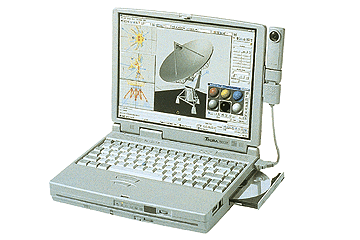
Zenith Data Systems was another participant in my early laptop experience.
These relationships deserve to be reconstructed from sponsorship letters, photographs and surviving equipment records. They are part of my personal technological archive, rather than claims of formal research partnerships.
But their significance to me was unmistakable.
I was discovering a principle that has remained central to my work:
Computing should follow human creativity, not confine it to a desk.
II. The InternetPhone: A Voice Before the World Was Ready
Archive (see below) · RTBF footage of the InternetPhone demonstration at L’Amour Fou. Another early experiment took place at the intersection of telecommunications, software and public demonstration.
At L'Amour Fou, an early cybercafé in French-speaking Belgium, I demonstrated an Israeli InternetPhone application on Belgian national television, RTBF.
This was an era before Skype became synonymous with Internet calling.
Watch the InternetPhone demo in the intro of my mid-length movie Tycallops Enthrocepsys:
Voice over IP was still an extraordinary idea to many people: a telephone conversation carried by the Internet rather than by conventional telephone infrastructure.
The original RTBF footage is particularly important to my archive because it offers something stronger than recollection: a contemporaneous audiovisual record of the demonstration.
I intend to recover, identify and present the precise broadcast details.
The lesson was not merely technical.
A demonstration could make a future technology intelligible to an audience that had never encountered it.
That combination — technology, performance and public understanding — would later become essential to the CyberThéâtre experience.
III. Nirvanet and CyberThéâtre: The Internet Becomes a Place
Archive placeholder · Brussels CyberThéâtre, 1997. Period venue photograph to be added when sourced and cleared.
By the middle of the 1990s, Brussels had become an unexpected laboratory of digital culture.

Nirvanet was more than a website.
It was an editorial environment, a cultural experiment, a gathering place for artists, technologists, musicians and people who sensed that the Web might become an entirely new social space.
The historical record identifies Christian Perrot and Marie-France Perez as the founders of Nirvanet, launched in March 1996.
The subsequent CyberThéâtre and Global Theatre Network venture brought together the Nirvanet cultural world and the organisational and commercial experience of figures including Philippe Brawerman and the wider founding team.
The original CyberThéâtre occupied a former cinema on Avenue Louise in Brussels.
Imagine a place combining Internet access, multimedia production, electronic music, video installations, emerging virtual-reality experiences, artistic performances, education and international networking.
That was the ambition.
It was not a conventional cybercafé.
It was a prototype for a hybrid physical and digital cultural institution.
And, for a period, it existed.
In May 1997, WIRED reported on the opening of the Brussels CyberThéâtre and the fusion of Nirvanet's online culture with a real-world venue.
In October 1997, Nirvanet received the Lewis-Carroll Prize at the Image et Science events. Contemporary coverage identifies CNRS Audiovisuel and the International Council for Film, Television and Audiovisual Communication, associated with UNESCO, as the awarding organisations.
In 1999, Nirvanet also won a separate UNESCO Web Prize, as reported by Unesco Platform Vlaanderen.
The distinction is important: this was a collective achievement, not a personal award.
My own contributions and experiences belong within that collective history, which I hope to reconstruct through original publications, archives and the recollections of the people who were there. Also I got my MyazakisEggs website integrated into Nirvanet. An early ode to the studioGhibli animation movies, I got an award from Annecy Animation festival back then.
I subsequently worked in environments including Mitsui-related activities, while continuing my interest in mobile computing, software, communications and creative technology.
The CyberThéâtre left behind more than a memory.
It left behind a question:
What happens when a digital community acquires a physical home — and when that home becomes a gateway to the world?
IV. Linux in My Pocket: The Nokia 9000 Experiment
Archive placeholder · The author’s photograph of the Nokia remote-terminal setup is still being sought.
Around the turn of the millennium, I was experimenting with a device that now looks like an archaeological artefact from the future.
The Nokia 9000 Communicator.
It was large, expensive and gloriously improbable.
It opened to reveal a keyboard and a monochrome display. Its processor belonged to the Intel 386 generation, and its native operating environment was GEOS.
It did not run Linux natively.

What fascinated me was something else.
Using its terminal facilities and a mobile data connection, I could access a remote Linux environment from a pocket-sized machine.
In practical terms, it meant carrying a command-line gateway into a Unix-like computing world while away from a conventional computer.
The experience was primitive by modern standards.
But conceptually it was extraordinary.
A personal computer no longer needed to be physically present in order to be useful.
The machine in my hands could become an interface to a machine elsewhere.
That is a principle we now take for granted in cloud computing, remote development and browser-based terminals.
I believe a photograph of my original setup survives somewhere in my personal archives. I am actively seeking it.
Until it is recovered, this remains a first-person account of an experiment rather than a fully documented technical demonstration.
Yet the idea has stayed with me for a quarter of a century.
The terminal was already becoming independent of the computer.
V. The Sony VAIO GT1: When a Laptop Became a Camera
Archive placeholder · Photograph of the author’s Sony VAIO PCG-GT1 to be added from the personal archive.
My fascination with unconventional hardware found another remarkable expression in the Sony VAIO PCG-GT1.

Released in 2000, this machine combined an ultraportable computer with a digital video camera featuring optical zoom.
It belonged to a brief, adventurous period when manufacturers were still experimenting with what a personal computer could physically become.
I acquired and worked with a particularly unusual GT1 unit, which I have described in my personal archive as a pre-production or prototype machine. Its precise production and provenance status should be confirmed against surviving serial-number and Sony documentation.
The GT1 became part of my filmmaking and technical experimentation.
My short film Smoking Duck, produced in the early 2000s, is one of the creative works associated with that period.
Years later, I returned to the GT1 as a preservation problem.
How could a Windows ME-era hybrid be kept useful when its original software environment had become obsolete?
My answer was to experiment with Puppy Linux, adapting a lightweight open-source environment to the machine's unusual hardware constraints.
Getting a working Linux environment was one victory.

Recovering complete support for the integrated camera was another matter.
The GT1's specialised imaging hardware presented driver and device-mapping difficulties, and I did not obtain a fully functional Linux solution for every camera feature.
That distinction is part of the story, not a failure to conceal.
Digital preservation is rarely a matter of pressing an installation button.
It is a process of understanding old hardware, reconstructing software dependencies and accepting that some components remain resistant to restoration.
The technical history of this effort belongs to my dedicated project archive:
Sony VAIO PCG-GT1 Project Blog
The GT1 remains a personal symbol of a larger conviction:
A computer's cultural life need not end when its commercial support does.
VI. From Open-Source Hardware to WebLinux
The same philosophy later brought me towards browser-accessible Linux environments.
My professional CV records an open-source project collaboration under WebLinux, associated with Télécom ParisTech, with references to the University of Illinois and Dartmouth College.
The stated activity was platform testing, beginning in 2018, with involvement around the period of my return to Belgium after years spent in Israel and Germany.
I regard this as a continuation of my long-standing interest in accessible computing.

From the Nokia's remote terminal to a Linux environment available through the browser, the underlying question was similar:
How do we make powerful computational tools available without requiring the user to own, configure or maintain an elaborate local machine?
The institutional scope and precise contribution history of the WebLinux collaboration still need to be reconstructed from repository records, correspondence and project documentation.
I therefore present this as a CV-recorded open-source contribution, not as a claim to have founded or directed an academic research consortium.
Its importance in my personal history lies in the continuity of the idea.
Make computing portable. Make it accessible. Keep it open.
VII. From Web Design to Artificial Intelligence
The technical story was never limited to hardware.
My early professional work included web design associated with IBM's NewMind subsidiary, Internet and intranet projects, and telecommunications programming.
My CV records work on a large European Commission intranet redesign, an EMakina-related European Parliament democracy portal, and billing and web-presence systems for Karuna International, a telecommunications startup active in low-cost telephony.
Each activity exposed a different layer of the emerging digital economy.
There was the public-facing Web.
There were internal institutional systems.
There was the infrastructure required to make communications services operate.
And there was the growing problem of making complex information understandable to human users.
Artificial intelligence entered my trajectory through another door: animal consciousness.
While preparing an audiovisual documentary pilot on that subject, I interviewed Professor Hugues Bersini, whose work at the Université libre de Bruxelles's IRIDIA laboratory helped connect my artistic and philosophical questions with computational research.

My CV records an earlier period of industrial collaboration with IRIDIA, approximately 2004–2008, including laboratory reporting, exchanges with researchers and relationships with other academic projects.
The precise appointment dates and institutional wording should be reconciled with original laboratory records.
In 2019, I completed the Elements of AI educational programme associated with the University of Helsinki.
That certification did not make me an AI pioneer overnight.
It formalised a field of interest that had been developing through my earlier work in computation, cognition, audiovisual experimentation and research.
The subsequent development of Ajinomatrix and my work on sensory intelligence, multidimensional experience and AI-assisted interpretation extended those interests into a new technological domain.
VIII. The DeviantArt Years: Creative Communities Before the Creator Economy
Another chapter unfolded in online artistic communities.
Under the identity Namasthay, I developed a presence on DeviantArt and became involved in its community and platform-testing culture.
My recollection is that I served as the #Apple-focused community lead and participated in long-running beta testing.

I was not a senior member of the DeviantArt organisation, and I do not present that involvement as an executive or corporate appointment.
What mattered was the experience of helping creative communities inhabit digital platforms.
DeviantArt represented a different form of online culture from the original CyberThéâtre, but the underlying questions were familiar.
Who creates the content?
Who maintains the platform?
Who owns the relationships?
How do creators gain visibility?
And what happens to their work when the platform changes?
These questions are no less urgent in 2026 than they were twenty years ago.
IX. The Archive That Was Almost Reopened
In April 2020, I was approached about, or considered for, involvement in efforts concerning the Nirvanet archives.
That involvement did not become an active archival assignment.
It would be misleading to suggest otherwise.
But the possibility reopened an important personal question.
What survives of the original Nirvanet and CyberThéâtre experience?
The websites?
The designs?
The multimedia works?
The photographs?
The recordings?
The memories of the people who built and visited those places?
An Internet culture can disappear even when parts of its technical infrastructure survive.
Preserving it requires more than restoring a domain name.
It requires recovering context.
The same applies to the early machines and software that shaped my own trajectory.
A photograph of a Nokia terminal, a working Sony VAIO GT1, an RTBF television recording, a forgotten website, an original programme or an interview can each become a piece of a much larger historical puzzle.
This is why I consider technological heritage an active creative discipline.
Preservation is not nostalgia. It is the recovery of possibilities.
But I wrote a book about the testimonies of the staff of the project - available here:
(The book is also available in English and parly annotated/corrected by Vint Cerf himself)
X. Virtual Palace: A New Architecture for Digital Culture
In my book Virtual Palace, published under the author identity Gabriel Wayenberg, I explored the idea of an environment where digital space can become more than a collection of pages and interfaces.

A palace is an architectural metaphor.
It contains rooms, thresholds, meeting places, galleries, stages, workshops and spaces for reflection.
Applied to digital culture, it suggests an environment designed for discovery and participation.
Visit the Virtual Palace virtually on it's page: https://www.virtualpalace.be
The original CyberThéâtre brought digital experiences into a physical building.
Virtual Palace points towards a complementary possibility:
A persistent digital environment capable of hosting cultural, educational, scientific and artistic experiences, potentially connected to physical venues.
Its future could involve immersive media, interactive exhibitions, digital performances, AI-supported guides, remote participation and new forms of creative collaboration.
The book is one intellectual starting point.
The proposed platform remains a project to be designed, scoped and validated.
XI. Nirvanet 2.0: Not a Replica, but a Renaissance
Nirvanet deserves to be remembered for what it was: a collective experiment in an Internet that had not yet been fully commercialised.
Its mixture of technology, culture, music, artistic freedom and international curiosity anticipated many features of contemporary online communities.
But recreating a 1996 website in 2026 would not be enough.
A meaningful Nirvanet 2.0 would need to recover the original spirit while addressing today's realities. See the landing page here: https://www.nirvanet.eu
Artificial intelligence has changed how information is created, interpreted and distributed.
Virtual reality has expanded the vocabulary of digital presence.
Robotics is creating new relationships between computational systems and the physical world.

And the concentration of online activity within a small number of commercial platforms has revived old questions about autonomy, openness and cultural ownership.
My proposal is therefore not simply to relaunch an old brand.
It is to explore a new cultural and technological framework, informed by the historical Nirvanet experience.
Any formal use of the Nirvanet name, historical assets or original project identity would require appropriate dialogue with the relevant people and rights holders.
Nirvanet 2.0 is, at this stage, a working proposition—not an authorised institutional successor.
XII. CyberThéâtre 2.0: Where Virtual Palace Meets Nirvanet 2.0
Here is the central hypothesis.
Virtual Palace provides the spatial and experiential architecture.
Nirvanet 2.0 provides the cultural, editorial and community ambition.
CyberThéâtre 2.0 becomes the possible meeting point between them.
I imagine a framework organised around several complementary functions:
The Living Archive — Recover and contextualise early digital culture, including the original CyberThéâtre, Nirvanet, historic hardware, websites, recordings and testimonies.
The Virtual Palace — Develop an immersive environment for exhibitions, performances, research demonstrations and collaborative encounters.
The Creative Laboratory — Explore AI-assisted artistic production, audiovisual creation, music, interactive storytelling and human-machine collaboration.
The Open Terminal — Continue the spirit of accessible computing through browser-based tools, educational environments and open-source experimentation.
The Robotics Stage — Investigate performances and demonstrations in which physical machines become participants in creative and educational experiences.
The Cultural Commons — Develop governance and participation models that respect creators, historical contributors, intellectual property and community autonomy.
The Physical-Digital Bridge — Explore partnerships with venues, institutions, festivals, laboratories and independent cultural spaces.
These are proposed programme areas, not claims of operational deployment.
The first task is not to announce a completed institution.
It is to assemble the people, the evidence, the technical architecture and the commitments that could make one possible.
XIII. Beyond the CyberThéâtre: The Bridge to BHG
There is another dimension to this journey.
My writing has increasingly explored the relationship between technology, cultural memory, spirituality, responsibility and peace.
In Beit HaMikdash Gimel: The Third Temple — Faith, Peace and the Architecture of a Shared Future, I examine sacred architecture and the possibility of imagining a more peaceful human future. Peace and never 2 without 3 - 2 & 3 form a hart figure...
The connection with Virtual Palace is not architectural equivalence.
A speculative digital palace is not a sacred Temple.
Nor does a cultural technology project confer religious authority.
The connection is philosophical.
Both ask what kind of spaces human beings choose to create, what values those spaces embody, and whether architecture—physical, symbolic or virtual—can encourage understanding rather than division.
For me, the bridge from CyberThéâtre to Virtual Palace and onward to BHG is a progression from connection, to community, to responsibility.
It is an invitation to think about technology as a contributor to human flourishing rather than as an end in itself.
XIV. A Call to the First Generation—and the Next
To those who were there in the 1990s:
The designers, programmers, artists, DJs, journalists, engineers, visitors, organisers, dreamers and occasional troublemakers of the early Web.
To those who remember Nirvanet, the CyberThéâtre, Brussels' first digital cultural spaces and the experiments that surrounded them.
To those who still possess photographs, press cuttings, software, recordings, invitations, equipment, screenshots or personal correspondence.
I would like to hear from you.
And to the next generation:
The AI researchers, open-source developers, VR designers, roboticists, filmmakers, musicians, educators and cultural entrepreneurs.
Perhaps there is a new kind of CyberThéâtre worth building together.
Not to reproduce the past.
To recover what was valuable in it—and carry it forward.
The first CyberThéâtre belonged to its creators and community.
A second-generation framework, if it emerges, must respect that history while finding its own legitimacy.
I do not claim to own that legacy.
I claim the right, as someone who lived through parts of it, to remember it, investigate it and propose a future informed by it.
Thirty years ago, we tried to give the Internet a home.
Today, we can ask whether intelligence, imagination and human community might inhabit a new one.
That is the TechnoFathering project.
And this is its opening declaration.
François Gabriel Wayenberg
Author · Filmmaker · Technological Heritage Researcher · AI Research Entrepreneur
Further reading and archives
Unesco Platform Vlaanderen, “Belgische site wint UNESCO Web Prijs” (1999).
VirtualPalace, Brussels VR hub — venue reference for the proposal.
Nirvanet.eu — the site presents itself as “Reborn 2026”. It is cited as context for the tentative proposal.
Science Museum Group collection record for the Nokia 9000 Communicator — model reference.
Sony’s PCG-GT1 product brochure — model reference.
Sony VAIO PCG-GT1 Project Blog — https://sonyvaio-gt1.blogspot.com
Lurch Productions — https://www.lurchproductions.net
Lurching — https://www.lurching.net
Ajinomatrix — https://www.ajinomatrix.com
WIRED, “Multimedia, Cultural Values Merge in Brussels” (1997) — https://www.wired.com/1997/05/multimedia-cultural-values-merge-in-brussels/
WIRED, “Euro Dream Job: Launch the CyberTheatre” (1997) — https://www.wired.com/1997/11/euro-dream-job-launch-the-cybertheatre/
Le Monde, “Nirvanet au firmament” (1997) — https://www.lemonde.fr/archives/article/1997/10/26/nirvanet-au-firmament_3809338_1819218.html
Virtual Palace, Gabriel Wayenberg — publication page pending verification
CyberThéâtre & Nirvanet: The Phoenixes of Web 2.0 — publication page pending verification
Beit HaMikdash Gimel — publication page pending verification
Historical disclosure: Personal recollections and CV-derived roles are distinguished from independently documented events. CyberThéâtre 2.0, Virtual Palace integration and Nirvanet 2.0 are proposed future initiatives; no endorsement by the original founders, institutions or rights holders is implied.


Comments